Ideas, thoughts and stories from One Magnolia. All about the people who make things work.
Thursday, 3 May 2012
Engagement in what?
So many people talk about employee engagement as an end in itself. Thinking of it in that way has some value (better than not doing it), but it is simplistic and vague. Just like PR, if you 'do employee engagement' for its own sake, you'll be lucky to see much ROI.
Employe engagement becomes really powerful when it is used like any other communications practice, to achieve strategic organisational goals. As Ivan points out (in more academic terms than I) the practice of engagement has a lot of levers it can pull on and an experienced strategist knows which areas to work on to achieve a particular result.
What this means (apart from being generally good news) is that a company should be reviewing its engagement strategy as often as it reviews its strategic goals. In the article Ivan gives the example of 'getting people to support and help each other' as something engagement can help to achieve. But even if the goal is the rather colder 'increase operating margin by 5%', the engagement practitioner has some levers they can pull to make it happen.
My number one piece of advice for anyone about to embark on some employee engagement work and wanting to get the most out of it, is to ask, 'Engagement in what?'.
Thursday, 12 April 2012
You say tomato, I say tomato
Thursday, 3 November 2011
Internal Comms and the Social Media Revolution

This article from Marketing Week caught my eye this week. Coca Cola are launching a new internal social network, as a mechanism to support their global employee base in staying connected. Sainsbury’s are apparently trialling the same thing although their objective seems a little less focused.
Social networks seem the obvious way to go for big companies and as more and more do it I shall be interested to see what the early results are. I think there will be sections of companies and industry sectors in which this works really well, and others in which it just doesn't fly.
Why? Well much depends of course on the thing being done well in the first place. Presuming a great job is done however, creating and sustaining an internal social network will still throw up all kinds of good questions for the trail blazers (which hopefully have great, innovative answers).
For example: how do you make this work for front line staff in the retail sector? Or for those who need to remain focused in call centres?
How do you get employees to engage with corporate social networks, when they already have enough going on with Facebook and Twitter? And how do you engage those sections of the company who have no interest in online networking at all?
What about the corporations who have banned F’book and Twitter under suspicion of lowering productivity? Do they feel differently if their staff are talking only to each other?
Honestly, I don’t know all the answers and it will be different for everyone. For a start though, internal comms professionals will need to be thinking about:
Focused, measurable objectives
Buy in at the highest level
Engaging managers
Intranet access at home
Mobile devices for non-desk based staff
Relevant, regular content
Identifying advocates
Engaging entry points
Maximising the online network offline
‘Social’ is set to become a prevalent part of the internal comms mix, and is already a key part of HR strategy for many. Today at the HR Tech Europe conference, the audience heard from Ian Bird, Social Learning Leader at IBM who says that, “social is the glue for hiring, learning and retention”. (IBM is a long time leader in this field with their maxim ‘not mass communication, but masses of communicators’ standing out from their social computing guidelines - which were themselves created in a wiki by IBMers).
My sense is that we are reaching a tipping point and that soon there will be few internal comms and HR professionals who can afford to ignore the social media revolution. I certainly don’t think every company should have their own social network, far from it. Depending on your objective, a social network for its own sake might be rather missing the point.
Rather companies should be thinking a bit further ahead, and facilitating the social behaviour of employees both on and offline - to learn, to share, have fun, and just get stuff done. Twitter is just the twip of the iceberg (sorry). What’s more interesting is to think about what something like Pinterest might mean for sharing great work across a global organisation, or what the corporate version of Streetbank might be if you applied it to skills instead of stuff... Oh and if you want to explore social learning, you could do a lot worse than take a look at NoddlePod.
There is so much great work just itching to be done here. Viva la revolution!
Thursday, 24 February 2011
Agility

Monday, 25 October 2010
Assume Nothing!


Tuesday, 12 October 2010
Work Space Design - An interview with trifle creative*

We all know instinctively that the space around us affects how well and how happily we do things in it. Anyone who has ever tried to join the Mile High Club in an aeroplane lavatory knows this to be true.
So work space design is an important thing for all businesses to consider. How productive can employees be in the space? Is it suitable for the kind of behaviour you want to foster? What about clients, or suppliers, does the space work for them? Whether you’re a one man band hanging out in a coffee shop, or a big old corporation these questions must be contemplated.
But while they’re easy questions to ask, finding the solutions can be a little more tricky.
To find out more and see if I could get some top tips for businesses, I spent some time with Emma Morley and Sejal Parekh from trifle creative*; a bespoke work space design company who passionately believe that every business can use their environment to drive increased productivity - whatever that looks like for them.
The trifle wisdom:
Start with the basics
trifle creative* believe that there’s no one size fits all way to design a work environment. What’s right for an ad agency, might be useless for a telecoms provider; so where do they start?
“All our work is insight led. We don’t form a judgement on a design until we have considered industry, brand, culture and people.’ said Emma, ‘We design spaces for each company to be a perfect fit to their culture... or to the culture they want to end up with.”
With remarkable self restraint when there are funky receptions to design, they start with the least sexy stuff. Storage and space design are key to giving each individual a space that they can work productively in.

“We’re very careful not to let aesthetics come before practicality. We spend a lot of time understanding the needs of all the stakeholders who encounter an office, then our design revolves around them,’ says Sejal, ‘we spend a huge amount of time on space planning for that reason, finding creative solutions for boring things like storage needs and cable management first.’
Understand the importance of personal space
It seems that much badly used space is to be found around desks, with cables everywhere and inefficient storage crowding in on people as they work. In these personal areas though, there is much resistance to change. It seems that separating people from their desk drawers is like whipping away an emotional crutch. Sejal explains why;
“Many employees don’t have much that they can control once they cross the threshold of their workplace. Their desk space ends up becoming a piece of their identity. Something they have dominion over and a sense of self around.”
Emma and Sejal have found that providing ways for people to express their own identities and take control of a space, can be dramatically effective in terms of behavioural change. “Whether it’s owning a locker for your coats and bags, or having a big wall with pictures of nights out or family - anything really - it helps employees to feel that their whole personality is recognised in the workplace. And for a place where you spend around 87% of your time, that’s psychologically very important.”
But pay attention to communal space as well
Most of the creative fun happens in companies’ communal areas, with individual workspaces being very much about design that enables good communication and a interesting working environment.
“But in communal spaces we can have some fun - and people get really excited by it!’ says Emma, ‘In particular, revitalising a kitchen has a massive effect on people’s feeling of being nurtured and appreciated.”
It’s not too hard to see the psychlogical reasoning here. Trifle also make the most of loos, reception areas and communal work spaces as key areas to create a great impression on both clients and employees and channel the spirit of the brand.
Another very important part of space design for productivity, is creating different zones for different types of working. People work in different ways, and with different jobs to do, so space needs to be flexible to accommodate that wherever possible.
“People know their own issues. We spend a lot of time gaining insight into what those are, and then come up with creative solutions to answer them.”
Facilitate Networking
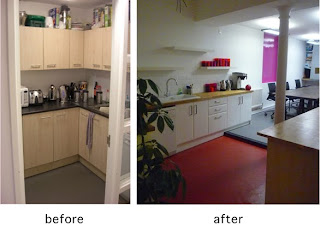
A key element of success in any organisation, (but one which can be difficult to create) is the network of internal relationships which enable smooth operations. Aside from team building exercises, companies can feel quite powerless in creating these channels of communication. Can the office environment help?
‘Absolutely.’ says Emma, ‘People naturally come together in communal hubs, so we create places where we know employees will bump into each other (not literally), and start to chat’.
The layout of an office can significantly impact the work that happens there and it can be hard to see things clearly when you’re there every day. Sejal told me,
“We went to one company which was struggling with project communication. We walked in and realised they were all spread out and in the biggest desks I’ve ever seen! The answer? Smaller desks, made room for people to be closer together. They could speak to each other more easily and sure enough, after the refurb, everyone was saying how great the atmosphere in the office was.”
Emma adds that another one of their great successes was fitting a tiny little breakfast bar into the staff kitchen of a small office. ‘It gave people the permission and opportunity for informal conversation - and suddenly everyone was having breakfast meetings!’
This is a really interesting point. Often people aren’t sure what behaviour is considered correct at work and what isn’t. If they’re seen sitting and talking over toast, do they look lazy? Employers who want to encourage strong relationships and serendipitous meetings need to make it clear that talking over toast is welcome behaviour.
Don’t be afraid of colour
I had, (naively) expected that Emma and Sejal would reel off a list of pleasing colour rules - like in that Dulux advert. The truth, it seems, is that colour is a very personal thing. People have different associations that one might not expect. Their general advice:
In any big space, use splashes of bright colours, rather than vast dominant swathes.
Blue and green are colours that we naturally associate with outside space. If you have a dark basement office with little natural light, these colours can be useful in bringing the outside in.

Grey is a great foil for bright colours and contemporary look - but use it sparingly or you’ll end up with corporate dullness.
It’s important not to expect too much from anything you do in isolation. Painting a wall in a bright colour won’t achieve much.
Challenge your preconceptions
“We try not to bring any preconceptions about the kind of company we are designing for and the look we should end up with. There’s a perception that it’s only agencies, (and specifically London agencies at that) who have bright colours and interesting office design; but it doesn’t have to be that way. There’s no reason why an accountancy firm shouldn’t have the design that fits their culture and their people. And there’s no reason why an accountancy firm always have to have white and beige and navy blue to reflect their culture.”
Budget - don’t assume it has to be expensive
I venture the opinion that budget must drive a lot of companies to have the colours, fabrics, and spaces they do. The pair insist though that a good design doesn’t cost any more than a poor one.
‘Offices don’t have to be officey!’ cries Sejal, and so starts a diatribe on the evil that is the office furniture catalogue, which it’s clear these two feel personally scarred by. They feel strongly that the expense, dullness and medium quality of furniture often found in the back of a stationery catalogue is a very high price to pay for the convenience of getting everything you want out of one book.
They use Ikea as an example of furniture and environments, where great (always fresh) design, functionality and budget find their midpoint. Emma admits though that while she loves to use some of the Ikea range, she has also learned what to avoid;
‘They’re brilliant when you are working to a restrictive budget, but you have to know what to stay away from. Some of their stuff is brilliantly durable, but there are other items that won’t last a year!
Finally - If you do just one thing
A final trifle tip from each of the founders?
Emma: “It’s about getting an external and internal balance. Communal areas for staff to collaborate & socialise in are equally as important as having an impressive reception. Consider what kind of message you want your brand to give and how that is delivered to all your stakeholders; clients, employees and others.”
Sejal: “Remember your brand is about more than logo and colour pallet, it’s about what you stand for and that’s how you should express it”.

Monday, 30 August 2010
Bad news can be inspiring
A couple of weeks ago I got an email from Posterous who I have a (totally unused) blog account with. The email was a very well worded apology that their servers had been hit by Denial of Service attacks and had buckled, and gone down. They came up again an hour or so later, but it seems the Posterous team and users continued to fight major problems for the rest of the week. Friday, 30 July 2010
Communication for Inspiration : Give your team Obama skills

‘My desk phone is broken. IT man has taken it away. And a replacement? "Oh, we haven't got any". Marvellous.’
The cause of the frustration humming through this little tweet, isn’t I don’t believe, the lack of a phone. The quotation marks speak volumes. The frustration has come from the way this impediment to his working day was communicated. As an afterthought. A fact - unsoftened.
Its not what you said, its how you said it.
This is the case with so many examples of dissatisfaction in the workplace. All kinds of things happen at work, some good, some bad, some challenging. But the thing that people get emotional about - for better or for worse - is the way they’re communicated.
In some cases people don’t see it as part of their job to manage the experience of those working with them. These people won’t be ultimately successful without realising their mistake and changing their minds about this. It will often take a manager to point it out and might require some coaching to find a new way.
Other times, the will is there, but there’s a barrier which stops people from understanding each other. What works in one department is foreign to another. I remember one halleluja of glorious understanding in a meeting between a production team and a design team, when they suddenly realised that they had two different concepts of what the word deadline meant. Genuinely. Once they each understood the pressures on the other team and why they thought about deadlines differently, they worked out some new language that worked for them. Conversations and relationships improved dramatically.
And it can be even harder for those who find themselves in senior leadership positions. Having got to the top of their particular tree they suddenly find themselves on another steep learning curve. They have new pressures to face, new responsibilities and overwhelming claims on their time. Simultaneously they become very visible, everyone listens to what they say, comments on it, judges it. Engaging communication is a big part of their job and if they get their communication style wrong, the impact on employee motivation can be huge.
So what’s to be done? Well over at One Magnolia we had a think about this little problem and took as our muse, the disarming Barack Obama. What would happen we wondered, if Barack Obama were on our leadership team, or indeed manning an IT service desk. We think the answer is that the people around him would be all fired up, full of energy, and that they’d get an awful lot done! As a result of this pleasing fantasy, we’ve developed Communication for Inspiration. A training course that takes the example of the greatest communicators of our time and makes their brilliance accessible for use by business leaders and managers.
The point isn’t to turn everyone into Barack Obama and Richard Branson of course. It’s to help leaders and managers find their own superpowers when it comes to engaging their staff. We give them the tools and make them easy to use.
The course finishes with a brainstorm on the ways for leaders to create a communication culture throughout their company. One person inspiring others through their communication is great, but a whole company doing it, the whole time, is better.
Call us on 07921 484 385, or email info@onemagnolia.co.uk to get course details of Communication for Inspiration : Give your team Obama skills.
Wednesday, 16 June 2010
Don't underestimate the girl on till 4

A 60 second exchange between two girls behind the tills at Waitrose yesterday reminded me that you can never can tell what someone's real skills are.
Friday, 11 June 2010
Engaging events

Friday, 23 April 2010
Practice makes it easy peasy

Tuesday, 30 March 2010
The 25th Hour

Thursday, 25 March 2010
Engaging for Success
The Department for Business, Innovation and Skills has commissioned a report on the importance of employee engagement in helping Britain out deep, dark recession. Friday, 12 March 2010
Innovation Beehive interview with Kursty Groves
“The first thing is that management have to use the creative space. If they role model behaviour, then others in the organisation will follow. Also, it has to be firmly on brand – the bouncy balls will only work at Google- they don’t fit the culture of a bank. You can’t just copy what is in one creative company and expect it to work the same in another”

Thursday, 3 September 2009
Shouting in capitals

This article from the BBC interested me.
The article goes on to speculate around the reasons why capital letters, mis-used, are so capable of causing grief. It seems to me though to be pretty clear. In email correspondance, writing in upper case is the equivalent of RAISING YOUR VOICE... and no-one likes to be shouted at. It seems this lady also sent instructions in bold and highlighted text in red. I don't even know her and I'm getting annoyed!
The thing is some people just aren't sensitive to this sort of thing, and genuinely don't know when they're causing offence. If anyone out there is unsure, might I suggest this rule of thumb: Pass all your emails through the internal client filter. If you wouldn't feel absolutely comfortable with the tone of your email for a client, then don't send it to a colleague either.
On the other hand some people know exactly what they're doing. AVOID THOSE PEOPLE.
Wednesday, 2 September 2009
Crystal clear

I didn't mind too much, I'm not a very high maintenance bride, but after a while I did start to think she had her priorities a bit wrong. Tuning in to the conversation it became clear that she was talking to her boss, I would guess the owner of the shop. She was having a detailed and lengthy conversation about the tiaras she felt should be ordered in and what process she thought they might adopt for re-ordering in the future. When she'd finished that, she moved on to the method of filing invoices - apparently one of the other girls had changed the system and she was unimpressed. *Sigh*.
Now I'm sure boss/owner was very pleased that her employee was being so organised and interested in the admin of tiara management. That said I'm equally sure that if the owner of this tiny, independent shop had known that there was a customer listening to the whole thing and being ignored he or she would have been absolutely incredulous... and then quite cross.
It served as a little reminder that owners/bosses/managers/CEOs need to be so clear as to what they want from their employees. To Wedding Shop Lady, being good at her job clearly meant being organised, tenacious and detail driven. All attributes which I'm sure no employer would scoff at; however I'm pretty sure Wedding Shop Owner would say that customer service comes before invoice filing in terms of importance.
The point is that you can't expect people to instinctively know that. If there is something that is important to you as a business owner you have to identify it and then broadcast that message. It has to be crystal clear. Like my tiara. Which I bought at Debenhams in the end.
Wednesday, 29 July 2009
Shoot your employees and get away with it
And hang on a minute, how an earth did this get past their legal team... and their HR department?! They do have one right?
Monday, 20 July 2009
Closed loop communications
Oh dear, oh dear. It would appear that I haven't blogged since April and it's now nearly the end of July. I think that counts as procrastination don't you?So then, a quick post (when procrastinating my advice is to do something, start small, get back in the swing), on a theme which is showing up as a problem for a few of my clients at the moment: Closing the loop on a conversation, or rather, not closing it. Comments like this are symptomatic...
"My boss said he was interested in any ideas I had when I joined, but none of my suggestions have been followed up".
"No idea sorry, we're always the last to know".
"Didn't someone say something about an office move at Christmas? Is that happening or what?"
This sort of dialogue can be light hearted, but if it's a regular occurence then boredom, frustration and cynicism are probably just around the corner. It's not that closed loop communication is hard, far from it, it's because it's easy that it gets forgotten.
Take the employee who goes to their boss with new idea. The boss listens, thinks it's a good idea and tells the employee he'll discuss with some others. EMPLOYEE EXCITED. In discussions it becomes clear that the idea won't work right now because of X,Y and Z but could work later on. The boss decides to review in 6/12 months. Great. Except the boss forgets to tell the employee what happened to the progress of his idea, because there's no real result yet. The employee is too embarrassed to chase up. EMPLOYEE SAD. (If it happens a second time it will be EMPLOYEE PISSED OFF).
The thing about this example is that most of the hard work was done. The manager made time to listen to the idea, took it forward, discussed its merits and made a decision. It was just the last little bit, which changes employee perception of the situation so drastically, that was forgotten.
My advice? Whatever level of a company you are at, get used to putting items on your to do list that start with "Get back to....". If YOU are the employee with the idea, then catch up with your boss to ask what happened to it, loops can be closed from either end!
Wednesday, 15 April 2009
Getting it Right - ?What If! Innovation
Let’s start at the beginning – the reception area. It IS a reception area in so much as there are welcoming people who’ll point you in the direction of the right meeting, but there’s a bit more to this space than that. It’s an eating area, a kitchen, a place for meetings, a place for parties, an internet cafĂ© and a space for congregation and recognition.
The walls and ceiling are completely and colourfully covered with nominations for the monthly values awards, ensuring that clients and employees alike are constantly reminded of what’s really important to this company. The nominations themselves are refreshingly down to earth. One for ‘Action’ was for someone who’d used CPR to save a delegate’s life when they had a heart attack in one of her coaching sessions. Another for ‘Bravery’, was awarded to someone who did their first ever pitch and blew the client away, even with their knees knocking.
“They just want to get involved. Everyone here does. We only hire the kinds of people who are really passionate and pro-active and who believe in our values”.
RECRUITMENT
So say you do want to, ‘get involved’ how do you get to be a part of the ?What If! team? Anyone can apply, however not unusually for a company with such a specific culture, many new hires are made by referral. This method of recruitment is so successful that there’s a standard introduction bonus of £2000 and a family tree which shows who introduced who on the wall in the kitchen area.
Even if you’ve been referred though, there are still a number of hoops to jump through. In Maz’s words,
“I think it’s probably easier to get into a MI5, than it is to get a job here”.
She’s probably right. First there’s a values based application, then a formal interview process in which a person's individual values are drawn out and aligned with the company’s. Then there’s a team interview, where the candidate has lunch with the team they’d be working with. And then a social interview, in the pub, where the candidate is taken out by a peers from across the business to ask questions and to see if they fit in.
Presuming all goes well the successful candidate then goes through a short but intensive induction process called The Academy which includes the popular creativity and innovation training that ?What If! are known for. In fact the induction process starts even before the new employee’s first day, when they are sent their ‘Love Box’. In the Love Box is everything you might want to know before your first day, and a little more besides. It includes the staff handbook Little Book of Nurturing which explains the ?What If! policy on caring holistically for their staff – but more on that later.
There’s also a lovely practice of asking the new person to come up with the ten things about themselves that their new colleagues might like to know. You can create the ten things in any format you like (unsurprisingly there tend to be more pictures than lists) and say whatever you want. You send your ten things back before your start date and they are pinned up somewhere for everyone to read. Hey presto on your first day, everyone has 10 easy conversation starters to choose from.
FROM A-Z
I’ve talked frequently in the past about how a company must make sure its recruitment process is scrupulously on brand; not only to allow engagement from the very beginning but importantly to make sure you get the right person for the job in the first place. However I can honestly say that it had never occurred to me that the way redundancies are handled should also be on message. However when ?What If! were forced to make a few of their cherished staff redundant in August this year, they put huge amounts of time and effort towards making sure that this too was done in a ?WhatIf! way.
A rigorous strategy and planning process was put in place to determine who, why and how – and what support they could give to these employees through the redundancy process and even after they had left the company. Having discovered what the people who were going to be leaving wanted to do next, ?What If! drew on their contacts and resources to try and help make it happen. Rather than just give plain old references, Maz sent out a personalised reference to prospective future employers detailing just why they were so sad to lose the person in question. She sent an email to everyone left behind asking what they would miss about their former colleague, collated their responses and added these into the reference. While I was there in fact, one of the ladies who had moved on popped in for a chat. Maz smiled and waved,
“It took a lot of hard work to plan a way of making redundancies that could be as painless as possible for those involved. But it was totally, totally worth it. These people are our friends, and they remain so – which I hope means we got it right”.
CONTINUOUS FEEDBACK
Maz told me that if there’s one thing that distinguishes ?What If! from all the other companies that she’s worked for, it’s their culture of continuous feedback. In fact she admits that it came as a bit of a shock to her when after a couple of weeks of being there, someone sat down with her and gave her some friendly thoughts on how she was getting on. She soon got used to it though, and clearly cherishes an environment where anyone can give feedback to anyone, whatever level of seniority, and it will be taken in the spirit in which it was given.
To make sure that ‘continuous feedback’ is something they do, not just say ?What If! don’t have yearly appraisals. Instead they have 3 monthly development conversations, casually referred to as BOB chats (Bringing Out Brilliance). To fit in with the fast moving culture, individual plans are constantly updated as existing objectives are met. Importantly line managers get specialised training on how to handle these conversations in order for both parties to get everything they need from them.
To help me appreciate how important ?What If! think this feedback culture is. Maz shares with me a vivid mantra which co-founder Matt Kingdon ‘says all the time’…
“Communicate until you puke”.
Charming. I’m sorry to tell you that this effective little phrase stays with you. It’s not a very pleasant image, but it’s pretty good advice – if in doubt, communicate some more.
BEYOND THE OFFICE
As they’re not a huge corporation, ?What If! have no obligation to produce an annual report – but they do a version of one anyway. Produced some time around March each year it is simply called “Our Impact – The Full Story” and covers everything from carbon footprint to client case studies. It also includes some top line results from the employee survey that is done each year; in which ?What If! survey not only their employees, but remarkably their friends and family as well. They ask the questions some employers don’t want to hear the answers to, about whether work is interfering with quality time, if their spouse/ roommate/ daughter tends to come home stressed or happy (or both).
Rather than just paying lip service to caring ‘about the whole person’ ?What If! provides numerous employee benefits that go above and beyond the schemes in place in most companies. To take a few from their “Freshness and Fairness” leaflet; free independent financial advice, sabbaticals, a visiting GP, £100 towards supporting stopping smoking, etc… What’s really eye catching though is the Friends and Family Helpline. It’s a support service which can be used to get professional, confidential advice on financial issues, emotional problems or legal advice. And this service can also be used by anyone who lives with the employee – parent, child, spouse or flatmate.
Also deserving of a mention is the Dream Catcher Award. If an employee has a dream (like writing a book, or creating a piece of art, or inventing something) and some time off and a bit of extra cash would help them to achieve it, ?What If! are interested in helping them to do it. Twice a year they award someone £1k and a week off work to go and get started on fulfilling their dream.
The ethos behind this is that if you want someone to perform to the best of their ability, you can’t just look after the part of them that comes to work, you have to care for the whole person.
“At the end of the day our clients pay for fresh, exciting minds. We do everything we can to make sure our employees are able to bring those exciting minds to work, if we didn’t it would affect our bottom line”.
SUMMARY
Frankly I could go on and on about the numerous, unusual ways ?What If! find to engage with their staff. They’ve probably come up with 5 new initiatives since I was last there. The point I think is that they never do nothing and whilst their methods are fun and quirky, they are based on sound, serious reasoning. Innovation is their whole raison d’etre and everything is geared towards supporting it. Here's how the ?What If! philosophy translates to their own working culture:
- Employees are always thinking about what they could do better or differently to create freshness at work.
- They give each other continuous feedback and are comfortable with praise, debate or constructive criticism, which means they live in a blame free environment in which it’s easier to be brave.
- The company provides employee benefits which take care of the whole person’s health and happiness, and are rewarded with people who love their jobs and are passionate about the company they work for.
- Employees are empowered to do what’s important to them, and reward those who take action, creating a culture of “I can and I will”. And they do!

